
| Music | 2 |
| Poetry | 1 |
| Change | 3 |
| Insight | 4 |
| Good | 2 |
| Total | 12 |
Explanation of Rating
Music – 2
This is a pretty boring song musically in my opinion, but it gets a two since it’s not bad. It also gives the impression that there’s a lot he could do with it live. I like the drums.
Poetry – 1
It’s a very straightforward and literal song, not particularly poetic. It’s telling a very clear story, with not much expressive language.
Change – 3
It’s got three different parts. The reason this scored so highly actually is because of how much I enjoy the part where the song slows down, “And though she finds it hard to leave him…”, I think that part is great, and worth listening until. There’s nice fluctuation between fast and slow, and I like the way he builds to the climactic moments.
Insight – 4
I think it’s a pretty unique song in its premise, especially coming from a man. Vivid imagery, and a compelling tale.
Good – 2
It’s pretty good. I personally like it, but wouldn’t rank it all the highly, or recommend it to a new listener. Or even as a deep cut.
Story
She walks through the front door, takes off her jacket, and goes around the house, lighting all the various candles. She makes it all look natural. She carries herself as she is, the definition of being “at home.” As I watch her, a stranger standing awkwardly in her doorway, I wonder if I’ve ever looked that way.
He used to complain that the way I walked around the house was wrong, and would call it ‘stomping’ around.
“Please quit stomping around, unless you’re trying to wake everyone in New York City.”
God only knows why it offended him. I used to apologize, until eventually I became too self-conscious to keep walking the way that felt natural to me. It’s hard to explain what being uneasy about your every step feels like. She clearly has none of it.
She was the waitress at the diner that I walked into this morning, my car having given up on me only a couple blocks away.
“Oh. You should stay at my place tonight.” She said as more of a statement of fact, than a kind offer.
“I’ll get off early, let me just text the other waitress.”
“Oh no you really don’t have to, I don’t mind waiting.”
“You look like you’ve spent a lot of time waiting already.”
I’m uncertain as to how to take that statement, so I just smile in response.
“Stay as long as you need,” she adds.
She tells me the story of choosing her couch, the painstaking months spent driving to stores, sitting, testing fabric swatches, ordering, sitting again, sleeping, returning.
“But a good couch will last me the rest of my life, so I figure if I only have to do it once it’s worth taking my time with it.”
I try to think of couches I’ve liked more than hers, but can’t. I’m moved by the amount of care that she puts into what is daily, habitual, overlooked. The things that most people dismiss, but will in actuality make up a majority of their lives. The location of the bed, the material of the sheets, the metal clasp for pinning the curtains back, the quality of the eggs, the shape of the spoons. The most comfortable couch I’ve ever been on.
“The things I like dedicating my time to, you’d never know.”
When I use the bathroom, I take a picture of the items she has in the shower. The soap, the shampoo, the conditioner, making a mental note to myself to buy the same ones once I move into my new place.
“What do you spend your time doing?” she asks in an attempt to get to know this stranger that she’s invited into her home.
“Right now I’m not so sure, sorry. I’m travelling. I mean, I’m on a trip, but I’m lost. I recently, I mean, before the trip, I left my home, and I don’t really have a destination, yet.”
“And that’s how you ended up in my diner.”
She has a habit of stating the obvious, with a dry smile, and when she smiles she doesn’t look at me, but instead right through me, seemingly at some larger cosmic joke.
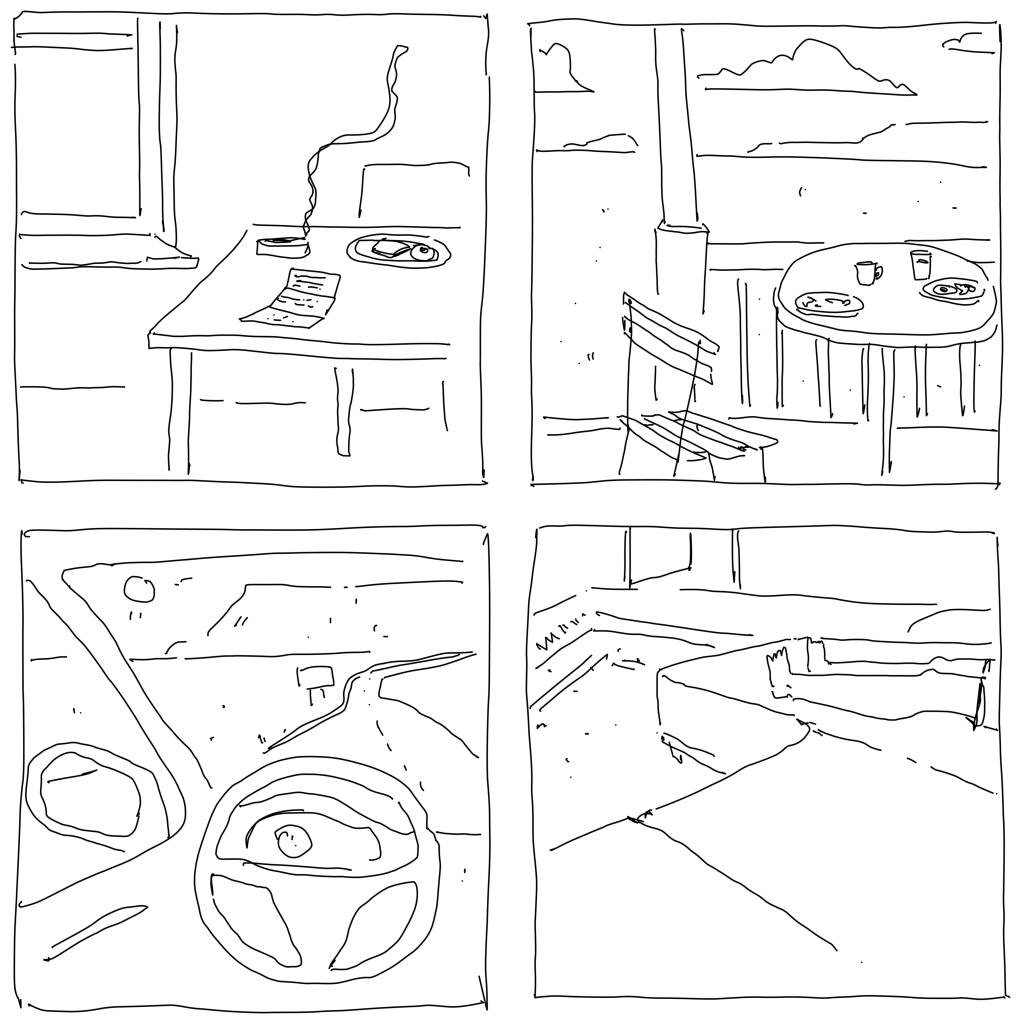
“I left someone behind. I don’t think he’s going to notice I’m gone for a while, so I guess that’s okay. It was time, I guess. I’m not totally certain of anything right now, to be honest.” She’s the first person I’ve told, besides the note I left for him on the kitchen table, weighed down by an overflowing ashtray. I’m having a hard time putting it all into words for her. While I speak, she patiently listens and waits for me to come to what I’m trying to say.
“I could say something about how we all go through it, about our moment here, but I won’t. I’m sure it’s been going through your head this whole trip anyway.”
Unlike me, she doesn’t joke, and I don’t once hear her laugh. But she seems happy. In a way that carries no necessity to prove it to anyone or anything, but quietly, to herself.
“How long do you think you’ll be in town?” she asks as she’s pulling sheets and towels out of the closet for me.
“Oh I’m not sure. I went to the diner because I have a problem with my car, and I’m not sure how to fix it yet. Hopefully not too long.”
I remember the weeks, months I spent pleading with him to take a look at the car. As it leaked, stalled, smoked, broke down, lost air from its tires, lost hubcaps and bumpers. As I pushed it ten city blocks. As it all but exploded. He’d tell me he’d get to it soon. As always, soon never came. And of course here I was, in the middle of nowhere, stranded. I knew he wouldn’t miss the car when I took it, as far as he knew it didn’t even run.
I stand next to her as she tidies up the house, getting everything together for us to have a night in. Her walls are lined with concert memorabilia and travel postcards. The sun is setting and casting a warm glow over the room. I’m enchanted by her motions and her strange way of speaking, as though she’s never fully listening, or maybe isn’t that committed to the conversation. She’s already on her second drink, even though we’ve only been back at the house for a little over an hour. She sits down on the couch next to me to watch some TV before bed.
In the morning I’ll wake up to the sounds of her cooking breakfast. I’ll walk into the room, which is adjacent to the living room where I slept. Her hands and body are fluent in the kitchen. I’ll watch, fully absorbed, as she moves around. It’ll remind me of a dance, and I’ll be tempted to film her, but know how much she would hate that. I’ll wonder if time will be as kind to me. I’ll admit she’s a rare exception, people her age tend to get slower, not faster. But with her no motion is wasted, her familiarity with her home will be envied by me for years to come.
Her fluidity will be an especially impressive accomplishment, as her kitchen is absurd. It’s tiny, with probably four square feet of floor space. She has no real fridge, as there’s no room, instead being replaced by a mini fridge and a mini freezer, at opposite ends, facing each other. They’re both packed to the brim. The lack of an oven is solved by a rinky-dink toaster oven sitting on the counter, caked in years of grime. A countertop burner has a cast iron pan on it, and she’ll be making a breakfast from the various ingredients she has ‘just lyin’ around.’ She’s graceful, calm. Her hands are worn from the decades of manual labor, but they’re as precise as a surgeon’s. I’m stunned by this, as I will have already somehow managed to spill something five minutes into waking up. She’ll hand me a paper towel almost immediately, anticipating my needs. To her, it’s all a ritual. To me, her rituals are poetry. She’ll make me feel like I fit in, like I’ve always been here. I make a mental note to try to make everyone in my new home feel that way.
Breakfast was always ‘our meal’, I’d wake up before him so I could surprise him with it in the mornings. We’d sit at the table, talking, eating. He liked his eggs sunny side up, not too runny. He’d put the whole yolk in his mouth so it wouldn’t get all over the plate. He always said thank you for breakfast, but would add salt and cheese before even trying what I had made. I wonder what he’s doing this –
“Your car is fixed.”
“What?” I almost choke on my mouthful of bacon.
“It’s fixed.”
“How?”
“I took care of it.”
“What? Why?”
“Because I could. Because you needed it. Because that’s the world I want to live in.”
The night before, as we are sitting on the couch, watching TV, I look over at her and ask:
“Can I massage your feet?”
Before she can answer, I place one of her feet into my hands.
“Umm… okay.”
As I start massaging, her body relaxes, sinks into the couch. She closes her eyes and tilts her head back until it’s resting on the back of the couch. Her feet are calloused and stiff, like his were.
“To be honest, I’ve been on my feet for twenty years,” her voice is soft and quiet, “they needed you.”
I smile as I knead them, happy to alleviate some of the infinite debt I feel. I don’t stop until I absolutely can’t do any more.
She gets up, thanks me again, wishes me a goodnight, and goes off to bed, her bedroom being only a couple feet away. I curl up on the couch, happy with the care we’ve found for each other. The amount of love that is still out there, in the world, for me. I cry at the grief of losing the last ten years to an accepted lack of it. She spares me the awkwardness of a confrontation, though I’m certain she can hear me crying into the couch cushion. I cry for what feels like hours, my first time since I left. Much like the feet, I needed the relief.
 Home
Home 